
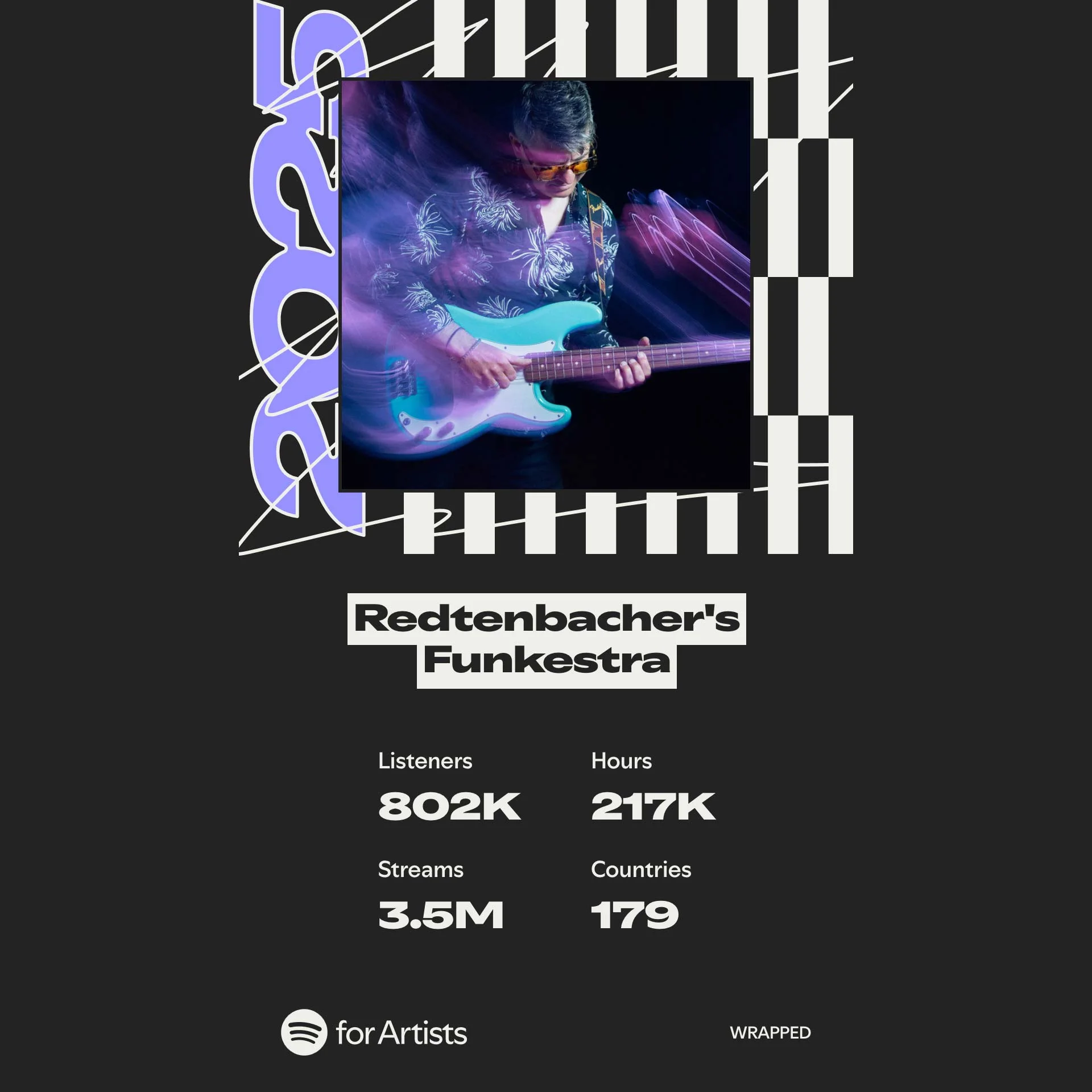
Spotify has released its 2025 Wrapped for artists – the annual 13-slide snapshot covering listeners, hours streamed, countries reached and more. The Funkestra’s numbers look strong, but raw stats only tell part of the story.
For the first time, I’ve taken a closer look at how these figures sit within the wider Spotify artist ecosystem and what they might reveal about our real position, alongside some broader questions about streaming, reach and impact beyond the platform itself.
1 What the Funkestra 2025 Wrapped actually says
Some simple ratios:
-
Streams per listener:
3,500,000 ÷ 802,000 ≈ 4.4 streams per listener over the year. -
Average listening time per stream:
217,000 hours ≈ 781M seconds → ÷ 3.5M streams ≈ 223 s ≈ 3:43 per stream
(i.e. people are typically staying for almost a full track, not just “tasting”.) -
Average listening time per listener per year:
217,000 hours ÷ 802,000 ≈ 16 minutes per listener over the year. -
Geography:
Spotify is available in roughly 180+ markets worldwide.
You hit 179 countries, so your catalogue is essentially global in reach.
CONCLUSION: wide but not yet “super-deep” engagement – a large number of people worldwide touch the catalogue, with a core repeatedly listening.
2 Position versus all artists on Spotify
How many artists are we comparing against?
Spotify’s own Loud & Clear FAQ states:
-
~12 million people have at least one track on Spotify.
-
About 235,000 of these have ≥10 tracks and ≥10K monthly listeners – Spotify’s proxy for emerging/professional artists.
The Funkestra’s current Spotify stats (from MusicMetricsVault’s Jazz-Funk page):
-
Redtenbacher’s Funkestra – 128,350 monthly listeners, 16,737 followers.
Spotify’s Loud & Clear calculator example (reported by iGroove) shows:
-
An artist with 100,000 monthly listeners sits around rank 44,000 globally.
Because the Funkestra is at c. 128K monthly listeners, our global rank will be better than 44,000 – realistically somewhere in the top 30–40K artists on the platform.
Using 12M total artists:
-
40,000 ÷ 12,000,000 ≈ top 0.3%
-
Even if we’re conservative and call it top 60,000, that’s still top 0.5%
Cross-check with streams / royalties
Spotify’s 2024 Loud & Clear report:
-
The 100,000th-ranked artist earned almost $6,000 in Spotify royalties in 2024.
Typical per-stream payout estimates are roughly $0.003–0.005 per stream.
-
The Funkestra 3.5M streams translate to a rough catalog royalty in the order of $ [hazard a guess] before label/distributor splits.
So in royalty terms the Funkestra should be comfortably above the 100,000th-ranked artist; again, consistent with a top ~50–80K global position – roughly the top 0.5–0.7% of all artists and well within the “professional / meaningful-income” cohort.
Summary vs all Spotify artists
Redtenbacher’s Funkestra is not in the superstar bracket, but clearly in the global professional tier: roughly top 0.3–0.7% of all artists on the service by audience size and annual streams.
3 Position within Jazz-Funk specifically
From the Jazz-Funk genre chart on MusicMetricsVault (which scrapes Spotify data):
-
Redtenbacher’s Funkestra
-
Monthly listeners: 128,350
-
Followers: 16,737
-
Genre rank: #117 in Jazz Funk.Music Metrics Vault
-
This same chart has:
-
Top of the genre: George Benson (~7.5M ML), Patrice Rushen (~3.9M), Herbie Hancock (~1.8M), etc.
-
Around you in the table: Yussef Kamaal, Tom Scott, Leon Ware, Ronnie Laws, Banda Black Rio, Orgone, etc.
Interpretation:
-
Within all artists Spotify tags as “jazz funk”, you’re already in roughly the top 120 acts globally by monthly listeners.
-
Given how niche and fragmented this genre is, that places Funkestra firmly in the upper tier of contemporary jazz-funk bands worldwide, sitting alongside legacy catalogue artists and international touring bands.
4 Putting it in plain terms
-
Scale: 3.5M annual streams and ~128K monthly listeners put you well inside Spotify’s professional bracket, and somewhere around the top few-tenths of a percent of all artists on the platform.
-
Genre position: In jazz-funk, you are already a named player in the global top ~120, sharing space with long-established acts and major catalogue names.
-
Global footprint: 179 countries listened – effectively worldwide penetration for a niche, instrumental-leaning project.
So: in Spotify terms, Redtenbacher’s Funkestra is a globally established niche act – not mass-market pop, but operating in the same statistical “band” as mid-level international artists, and in the top slice of jazz-funk worldwide.
5 Thoughts beyond the numbers
Spotify is a heavily debated platform for artists and the music industry at large. At some point I may set out in detail why I continue to use the service, but for now I want to share a few thoughts on the recent pushback against Spotify over its alleged investment links to military technology and, in particular, claims that this “funds equipment that kills children in Gaza” and similar statements.
My intention is to contribute to a serious, fact-based discussion rather than to reinforce black-and-white positions. If you’d like to comment, I’d be grateful if you could share your views respectfully and keep the temperature down so the conversation can remain meaningful. This is something I think about every day and, the more I look into it, the more it appears to be a complex grey area rather than a simple binary issue.
Let’s get stuck into some research.
Spotify does not invest corporate funds in weapons makers rather than Daniel Ek himself via an investment firm called Prima Materia of which he is a co-founder. Prima Materia had invested into Helsing which supplies AI systems and has moved into manufacturing drones, aircraft and submarines, with contracts in countries such as Germany, the UK, Sweden and Ukraine.
Is this a reason to not use Spotify as a digital music platform service – this obviously depends on each indivividual and their beliieve system and ethics I suppose.
It certainly peaked my interest resulting in me looking into Zuckerberg, Meta, Google, Amazon and Apple and their involvement and investment into the military industry. Somewhat unsuprisingly they all are involved to various degrees.
AMAZON
If you use Amazon Music, you are using a service inside a group whose cloud division has long-standing, large-scale defence and intelligence contracts. That is a different profile from Ek personally backing a defence startup, but clearly a direct government/military business relationship
APPLE
Apple’s situation is more indirect/industrial than Ek–Helsing, but Apple does intersect with defence via an acquired AR supplier with military contracts and a key supplier that is also funded by the Pentagon.
ALPHABET/GOOGLE/YOUTUBE
Alphabet/Google has substantial and growing collaborations with military and defence establishments, via:
-
-
historical and potential future AI programmes (e.g. Maven, revised AI principles),
-
large cloud contracts with the U.S. DoD (JWCC, Navy task orders, AI initiatives), and
-
the Project Nimbus contract with the Israeli government and defence apparatus
-
-
Alphabet’s VC arm GV also holds a significant stake in the defence-tech firm Anduril.
-
YouTube, as a platform inside this group, plays a major role in military digital marketing and recruitment, but it is not itself a weapons manufacturer or major equity investor in defence companies based on public information.
META (FACEBOOK, WHATSAPP, INSTAGRAM)
The parent company Meta now collaborates directly with defence contractor Anduril to build XR equipment for the U.S. military, which is a clear – albeit product-, not equity-based – military relationship.
MARK ZUCKERBERG
(Zuckerberg is on the order of 25–30× richer than Ek.)
Zuckerberg’s overall capital deployment (given its size and CZI’s role) is more heavily weighted towards medical, educational and justice/humanitarian work, with defence exposure mainly through Meta’s Anduril XR contract, not through his main philanthropic vehicle.
How I interpret this
The data broadly confirms my instinct that most major tech and media companies have some form of direct or indirect involvement with the military and its advancement. There is a certain irony in all of this: discovering Daniel Ek’s defence investments via Google’s search engine, sharing opinions on Facebook or Instagram, using an Apple phone or computer to do so, contemplating a move from Spotify to YouTube (Alphabet) or Amazon Music – all of these actions, to varying degrees, still support corporate ecosystems with military links. Where do we draw the line? (Again, I’m not talking about the basic ethics of streaming services here, but specifically about direct and indirect involvement in military development.) It is complicated.
Looking at it from another angle, Meta, Amazon, Apple and Alphabet are all US-based companies. Spotify, by contrast, is Swedish – a European company. Daniel Ek investing in a European defence-tech player may not be entirely negative in itself, particularly at a time when the current US administration appears less inclined to shoulder European defence concerns to the extent it once did.
Emotionally, I still find all of this deeply disturbing. I grew up in a time of relative hope: the fall of the Berlin Wall, Glasnost, and a general move towards disarmament between the two major powers. That world has changed. New actors have entered the global stage and many of humanity’s old, ugly ghosts seem to have reappeared.
So who will protect European values, principles and interests in the future? Goodwill alone and historic alliances will probably not be enough. In that light, Daniel Ek investing in European defence systems may not be altogether bad.
The question of how he achieved his wealth is different from the question of what he does with it now. And beyond military investment, he is also involved in health and environmental initiatives.
I look forward to hearing your thoughts.
Carpe funkem,
Stefan
PS Full disclosure: I used ChatGPT in a deep-dive research mode to explore the available facts. There may well be errors, gaps or misinterpretations, but I still see this as a useful starting point for discussion.